Professional Permanent Colored Pencils: Complete Guide 2026
Choosing pencils · layering · paper · lightfastness
Professional colored pencils offer different combinations of coverage, point retention and layering behavior. The best choice depends on your drawing, paper and working pressure. This guide explains how to compare them without treating a brand name, binder or large set as a guarantee of better results.
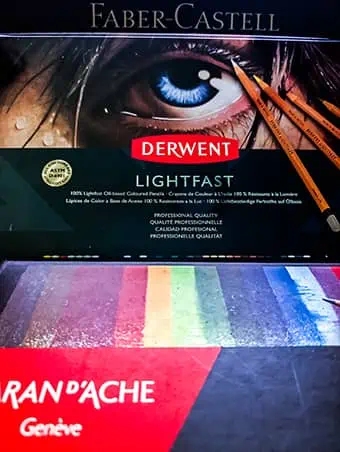
Five professional colored pencil ranges to compare
The descriptions below combine practical selection criteria with manufacturer specifications. They are not a scored laboratory comparison. Color availability, packaging and individual-pencil stock can vary by region; check the current chart for the product you plan to buy.
| Range | Manufacturer information | What to test on your paper |
|---|---|---|
| Faber-Castell Polychromos | Water-resistant artist pencils with a 3.8 mm core. Sets and individual colors are listed separately. | Fine lines, light layers and how long a sharpened point suits your details. |
| Caran d’Ache Luminance 6901 | A wax-based range with a 3.8 mm core. The manufacturer’s 100-color set uses ASTM D6901 lightfastness categories I and II. | Coverage, pale colors, transitions and the effect of layering over darker tones. |
| Derwent Lightfast | An oil-based range of 100 colors, rated I or II under ASTM D6901 by the manufacturer. | Gradual shading, color mixtures and the balance between coverage and detail. |
| Prismacolor Premier Soft Core | Soft, wax-based pencils offered in sets including 150 colors. | Broad coverage, blending, point maintenance and the ratings of the particular colors you need. |
| Holbein Artists’ Colored Pencils | The manufacturer describes an oil-based range of 150 colors with a 3.8 mm core. | Light layers, small details, coverage and combinations from its broad color selection. |
These facts describe the named ranges. They do not establish that one is universally softer, stronger or better than another. A pencil’s formulation involves more than a simple wax-versus-oil label, and individual colors within a range may behave differently.
Choose for the marks you want to make
For hair, eyelashes, fur and small decorative edges, compare how easily you can maintain a useful point and draw controlled lines. For broad backgrounds or expressive gradients, compare coverage and the effort needed to join two colors. For portraits, look for useful value steps and colors that suit your reference rather than buying a set solely because it is labeled for skin.
A soft pencil can still make fine marks when sharpened. A firmer-feeling pencil can still blend through light layers. Test both tasks instead of assigning an entire brand to only one technique.
A repeatable test before buying a large set
- Use the same paper. Write down the range, pencil color and surface. Changing all three together makes the comparison difficult to interpret.
- Make a pressure scale. Start with a faint layer, then build a medium and a deeper area. Use comfortable pressure; there is no calibrated hand-pressure percentage you need to reproduce.
- Draw fine lines. Try a few hair strokes, a curve and a sharp edge. Note when you need to sharpen again.
- Layer two colors in both orders. Apply one color first, then the other. Reverse the order nearby. Compare the transitions and the visible paper grain.
- Try one correction. Gently lift a small area with a kneaded eraser. Avoid repeated rubbing, and do not assume the paper will return to its original white.
- Record your result. Note which combination meets your drawing’s needs. Buy individual replacements or a small selection when available before committing to a larger box.
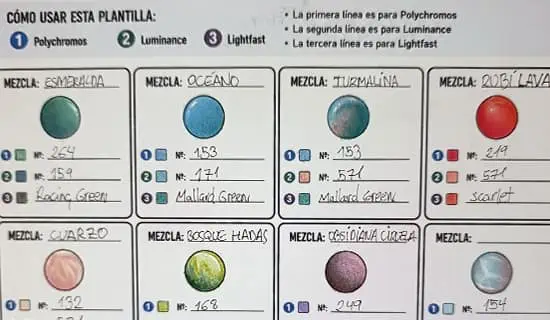
For your own notes, download the English blank color chart: A4 PDF with 36 swatches. Write each pencil’s name and number beside its sample.
Paper, layers and finishing pressure
Paper weight measures mass per square meter, not how many pencil layers a surface can accept. Tooth, sizing, fibers, pencil formulation and pressure all affect the result. Smooth paper can help with precise details; a more textured surface may hold pigment differently and leave more visible grain.
Start with light layers so you can adjust value and color. Increase pressure only when the drawing needs it. Burnishing compresses the surface and changes the finish; a pale burnishing pencil can also lighten or mute the mixture. Test it near the end of your sample rather than assuming it always increases contrast.
There is no universal maximum number of colors or layers for one patch. Stop and reassess when the surface no longer accepts pigment usefully, the point slides without changing the color, or the paper shows damage.
If you print a coloring page, check your printer’s supported paper type, thickness, weight and feed method. A suitable drawing surface is not automatically suitable for home printing. See the paper comparison and testing guide.
Build a small palette around useful roles
Choose a light color, a base, a transition, a dark color and an optional accent. A portrait palette should follow the person and lighting in your reference: skin is not one fixed hue. For shadows, compare a darker related color with a carefully tested cooler or warmer mixture. Complementary colors can reduce saturation, but they are not a universal recipe for every skin tone or lighting condition.
Organize what you already own in the Colored Pencil Atlas, then explore palettes by theme and brand. Screen swatches are approximate: confirm important combinations with real pencils on your chosen paper.
Sharpening and everyday care
Use a sharp blade and a sharpener that fits the pencil’s barrel. Turn gently and stop when the point suits the task; a needle point is unnecessary for every area. If sharpening repeatedly tears the wood or breaks the core, check the blade, fit and pressure before blaming the pencil range.
Store pencils so they are protected from impacts. Keep the paper free of loose pigment and use a clean sheet under your drawing hand when useful. Follow the manufacturer’s instructions for any blender or other medium; you do not need a solvent to practice dry layering.
What lightfastness tells you
Lightfastness describes resistance to color change under specified light-exposure tests. Read the rating for the particular color and the manufacturer’s explanation of its scale. A rating is not a guarantee that a drawing will remain unchanged for a fixed number of years in every room.
For work you intend to preserve, consider the paper, pencil ratings, display lighting and mounting together. Avoid direct sunlight. A high paper weight, an expensive box or the word “professional” does not replace checking these details.
Frequently asked questions
Do I need all five brands?
No. Learn how your current pencils respond before adding more. A few individual colors can fill a useful gap without buying another large set.
Are wax-based pencils always soft and oil-based pencils always hard?
No. Those labels do not fully describe a formulation or its behavior on a particular surface. Compare coverage, point retention and layering directly.
Can I mix brands in the same drawing?
Yes. Test the layer order and surface response first. Similar color names or numbers do not guarantee matching colors across brands.
Which paper works with every pencil?
No single paper is best for every drawing and technique. Compare two surfaces with the same pencils, then choose using your priorities: detail, layering, blending or work on a toned base.
How do I choose a first set?
Consider your subjects, useful light-to-dark steps, replacement availability and budget. Review the actual color chart and try samples where possible. A larger color count alone does not establish better quality.
Manufacturer references
Product information reviewed on October 18, 2026. Check the exact version and current regional listing before purchasing.
- Faber-Castell: Polychromos artist pencils
- Caran d’Ache: Luminance 6901, 100-color set
- Derwent: Lightfast questions and specifications
- Prismacolor: Premier Soft Core sets
- Holbein: Artists’ Colored Pencils
By Javier Origin, visual artist and educator. Continue on Instagram, watch YouTube lessons in Spanish, or explore the Ko-fi shop.
Leave a Reply
You must be logged in (Español) to post a comment.